4. 前馈网络(FFN)—— 手搓 NumPy vs PyTorch(含 SwiGLU 变种)¶
本 notebook 手搓 Transformer 的位置级 MLP(逐 token 前馈网络),对比 ReLU/GELU/SiLU 激活, 并实现现代 LLM 用的 SwiGLU 门控变种(MiniMind/LLaMA 的 FeedForward 就是它)。
前置:第 1-2 讲(注意力)。FFN 是每个 Transformer 层的第二个子层,负责"记忆/转换"每个 token 的表示。
核心概念¶
(a) 🗂️ FFN:逐 token 的升维-非线性-降维¶
手搓 Transformer 位置级前馈网络 Linear1→激活→Linear2 及其反向传播,对比 ReLU/GELU/SiLU 特性,并手搓 MiniMind/LLaMA 同款 SwiGLU 门控变种。
flowchart TB
    A["📝 公式回顾<br/>Linear-激活-Linear"] --> B["🧮 手搓线性层<br/>y=xW+b 与反传"]
    B --> C["⚡ 激活函数<br/>ReLU/GELU/SiLU"]
    C --> D["🔄 PyTorch 参考<br/>nn.Linear+F.gelu"]
    D --> E["✅ 数值验证<br/>forward+梯度+差分"]
    C --> F["🚪 SwiGLU 变种<br/>SiLU 门控×up 再 down"]
    F --> G["🎨 结构可视化<br/>gate/up/相乘色块"]
- 📝 公式回顾:FFN = Linear(d→d_ff) + 激活 + Linear(d_ff→d),逐 token 独立计算。
- 🧮 手搓线性层:forward 是 y=xW+b,反传 dx=dout·Wᵀ、dW=xᵀ·dout,注意与 torch 的转置约定对齐。
- ⚡ 激活函数:对比 ReLU/GELU/SiLU 的曲线与梯度特性,解释现代模型为何弃 ReLU 选 GELU/SiLU。
- 🔄 PyTorch 参考:用 nn.Linear + 激活组装两层 FFN,载入与手搓相同的权重。
- ✅ 数值验证:forward 与全部梯度(dx/dW1/db1/dW2/db2)对比 + 有限差分自检全 PASS。
- 🚪 SwiGLU 变种:down(SiLU(gate(x)) ⊙ up(x)),三个线性层的门控前馈,MiniMind/LLaMA 标配。
- 🎨 结构可视化:用色块示意 gate / up / 相乘三个张量的形状变换。
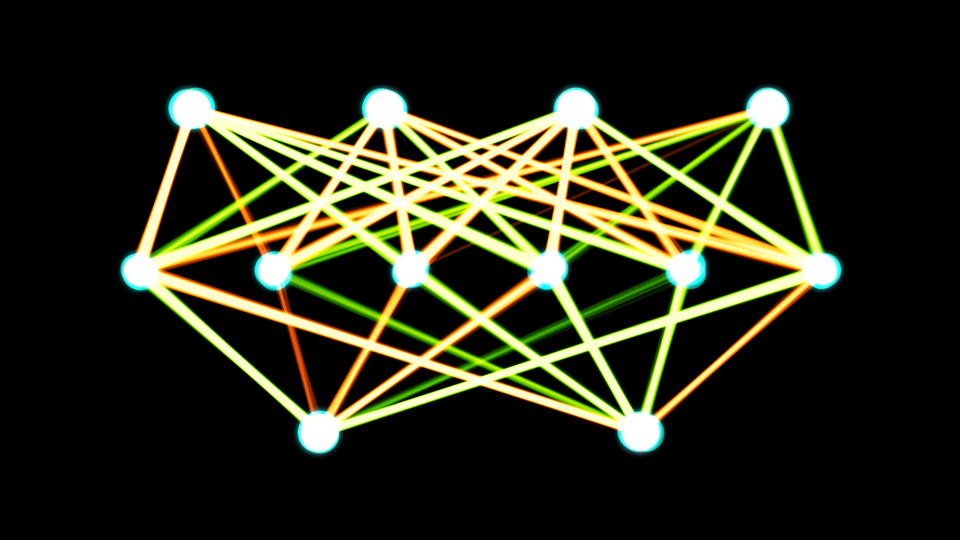
🕸️ 网络配图(Wikimedia Commons)
📷 来源:Wikimedia Commons · <a href="//commons.wikimedia.org/w/index.php?title=User:Akritasa&act…
公式回顾¶
原始 Transformer(ReLU):
$$FFN(x)=\max(0,\ xW_1+b_1)W_2+b_2$$
GELU(高斯误差线性单元,tanh 近似):
$$GELU(x)\approx 0.5x\left(1+\tanh\left(\sqrt{2/\pi}\,(x+0.044715x^3)\right)\right)$$
SwiGLU(LLaMA/MiniMind 用,门控线性单元 + Swish):
$$FFN_{SwiGLU}(x)=W_{down}\,\big(SiLU(W_{gate}\,x)\odot W_{up}\,x\big),\qquad SiLU(x)=x\cdot\sigma(x)=x\cdot\frac{1}{1+e^{-x}}$$
SwiGLU 用 3 个线性层(gate/up/down),其中 gate 学一个"门控"乘在 up 的输出上——比 ReLU 的硬截断更平滑, 给网络更强的非线性表达能力(参数量略增:$2d_{ff}\to 3d_{ff}$ 的中间层)。
✍️ §1.1 手算 FFN:ReLU 两线性层的完整数值链(附 GELU 对比)¶
$FFN(x)=\max(0,\,xW_1+b_1)W_2+b_2$——代一组小权重,把"升维 → 非线性 → 降维"算到底。
设定:$d_{in}=2,\ d_{ff}=3$,输入 $x=[1.0,\ 2.0]$,权重(手搓约定 $y=xW+b$,$W:[in,out]$):
$$W_1=\begin{bmatrix}0.5&-0.2&1.0\\0.1&0.8&-0.5\end{bmatrix},\quad b_1=0,\qquad W_2=\begin{bmatrix}0.3\\0.6\\-0.4\end{bmatrix},\quad b_2=0.1$$
第 1 步:升维($xW_1$,2 维 → 3 维)
$$xW_1=[0.5\times1+0.1\times2,\ -0.2\times1+0.8\times2,\ 1.0\times1-0.5\times2]=[0.7,\ 1.4,\ 0.0]$$
第 2 步:ReLU 非线性(负值截断为 0;这里恰好全正)
$$h=\max(0,\,[0.7,1.4,0.0])=[0.7,\ 1.4,\ 0.0]$$
第 3 步:降维(3 维 → 1 维输出)
$$y=hW_2+b_2=0.7\times0.3+1.4\times0.6+0.0\times(-0.4)+0.1=0.21+0.84+0.1=1.15$$
GELU 对比(同一组权重,激活换成 GELU $\approx0.5x(1+\tanh(\sqrt{2/\pi}(x+0.044715x^3)))$):
$$\text{GELU}(0.7)=0.5306,\quad \text{GELU}(1.4)=1.2867,\quad \text{GELU}(0)=0$$
$$y_{gelu}=0.5306\times0.3+1.2867\times0.6+0.1=0.1592+0.7720+0.1=1.0312$$
再看负区:$\text{GELU}(-0.2)=-0.0841\neq0$,而 $\text{ReLU}(-0.2)=0$——GELU 不硬截断,小负值仍保留一点梯度。
手算收获:
- FFN 的关键是"中间变宽再变窄"(2→3→1),非线性夹在中间——升维给更多线性组合空间,ReLU 提供非线性
- 只要 $W_1$ 某列对当前输入算成负值,$h$ 里就出现 0,该路梯度断掉——FFN 稀疏性的来源
- GELU 是 ReLU 的平滑版:负区≈0 但不等于 0(-0.0841),正区略小于 ReLU(0.5306 < 0.7)——梯度更稳,现代模型标配
- 输出 1.15 说明"特征被重新混合":FFN 是逐 token 的变换,叠门控结构(gate/up)就成 SwiGLU(见后文)
下面 numpy 复算。
# ---- §1.1 验证:numpy 复算 FFN(ReLU 与 GELU)----
import numpy as np

x = np.array([1.0, 2.0])
W1 = np.array([[0.5, -0.2, 1.0], [0.1, 0.8, -0.5]])
W2 = np.array([[0.3], [0.6], [-0.4]])
b2 = np.array([0.1])

def gelu(v):
    a = np.sqrt(2.0 / np.pi) * (v + 0.044715 * v ** 3)
    return 0.5 * v * (1.0 + np.tanh(a))

h = x @ W1                        # 升维 → [0.7, 1.4, 0.0]
h_relu = np.maximum(h, 0.0)
y_relu = (h_relu @ W2 + b2)[0]
h_gelu = gelu(h)
y_gelu = (h_gelu @ W2 + b2)[0]
print(f'h = {np.round(h, 4)}')
print(f'y(ReLU) = {y_relu:.4f}(手算 1.15)')
print(f'y(GELU) = {y_gelu:.4f}(手算 1.0312)')
print(f'GELU(-0.2)={gelu(-0.2):.4f} vs ReLU(-0.2)=0;GELU(0.7)={gelu(0.7):.4f} vs ReLU(0.7)=0.7')
assert np.allclose(h, [0.7, 1.4, 0.0], atol=1e-9)
assert abs(y_relu - 1.15) < 1e-9
assert abs(y_gelu - 1.0312) < 1e-3
assert abs(gelu(-0.2) + 0.0841) < 1e-3 and abs(gelu(0.7) - 0.5306) < 1e-3
print('\n✓ 与手算一致:ReLU 与 GELU 两条 FFN 数值吻合')
导入¶
# ---- matplotlib 中文字体(防图内中文乱码)----
import matplotlib
matplotlib.rcParams['font.sans-serif'] = ['Microsoft YaHei', 'SimHei', 'Songti SC', 'Arial Unicode MS', 'DejaVu Sans']
matplotlib.rcParams['axes.unicode_minus'] = False
# -------------------------------------------
import numpy as np
import torch
import torch.nn as nn
import torch.nn.functional as F
import math

np.random.seed(0)
torch.manual_seed(0)
print('imports ready')
imports ready
手搓实现(纯 NumPy,含手搓反向传播)¶
linear_forward/backward:线性层 $y=xW+b$,$dx=dout\,W^T$,$dW=x^T dout$(对 B,T 维求和),$db=\sum dout$relu_forward/backward:$y=\max(x,0)$,$dx=dout\cdot[x>0]$gelu_forward/backward:tanh 近似;导数为 $0.5\tanh(a)+0.5x(1-\tanh^2(a))\cdot\sqrt{2/\pi}(1+3\cdot0.044715x^2)$,$a=\sqrt{2/\pi}(x+0.044715x^3)$ffn_forward/backward:$x\to$ 线性1 $\to$ 激活 $\to$ 线性2 $\to$ out,用 cache 链式反传
def linear_forward(x, W, b):
    """线性层 forward:y = x @ W + b。
    x: [*, in];W: [in, out](行=输入、列=输出,与 torch Linear 的 [out,in] 相反,赋值时转置);b: [out]"""
    return x @ W + b

def linear_backward(dout, x, W):
    """线性层 backward:dout: [*, out],x: [*, in]。
    返回 dx = dout @ W.T([*, in])、dW = x^T @ dout 对前置维求和([in, out])、db = sum(dout)([out])"""
    dx = dout @ W.T
    dW = (x.reshape(-1, x.shape[-1]).T @ dout.reshape(-1, dout.shape[-1]))
    db = dout.reshape(-1, dout.shape[-1]).sum(axis=0)
    return dx, dW, db

def relu_forward(x):
    """ReLU forward:max(x, 0)。"""
    return np.maximum(x, 0.0), (x > 0)

def relu_backward(dout, mask):
    """ReLU backward:梯度只在 x>0 处通过(mask 是 x>0 的布尔掩码)。"""
    return dout * mask

def gelu_forward(x):
    """GELU forward(tanh 近似,与 torch F.gelu(approximate='tanh') 一致)。"""
    a = math.sqrt(2.0 / math.pi) * (x + 0.044715 * x ** 3)   # 内部参数 a
    return 0.5 * x * (1.0 + np.tanh(a)), a

def gelu_backward(dout, x, a):
    """GELU backward(tanh 近似的解析导数)。
    g(x)=0.5x(1+tanh(a)),a=√(2/π)(x+0.044715x³):
    g'(x)=0.5(1+tanh(a)) + 0.5x(1−tanh²(a))·√(2/π)(1+3·0.044715x²)"""
    t = np.tanh(a)
    dgelu = 0.5 * (1 + t) + 0.5 * x * (1 - t ** 2) * math.sqrt(2.0 / math.pi) * (1 + 3 * 0.044715 * x ** 2)
    return dout * dgelu

def ffn_forward(x, W1, b1, W2, b2, act='gelu'):
    """两层 FFN forward:x -> Linear1 -> 激活 -> Linear2。
    返回 (out, cache):cache 保存中间量供 backward 复用。"""
    h_pre = linear_forward(x, W1, b1)              # 线性层1:升维 [*, d_ff]
    if act == 'relu':
        h, mask = relu_forward(h_pre)             # ReLU 激活
        cache = (x, W1, b1, W2, b2, h_pre, h, mask, None)
    else:  # gelu
        h, a = gelu_forward(h_pre)                # GELU 激活
        cache = (x, W1, b1, W2, b2, h_pre, h, None, a)
    out = linear_forward(h, W2, b2)               # 线性层2:降维回 d_model
    return out, (cache, h)

def ffn_backward(dout, cache_info):
    """FFN backward(链式反传):dout -> 线性2 -> 激活 -> 线性1。"""
    (cache, h) = cache_info
    x, W1, b1, W2, b2, h_pre, h_act, mask, a = cache
    dh, dW2, db2 = linear_backward(dout, h_act, W2)     # 线性层2 反传
    if mask is not None:                                 # ReLU 分支
        d_pre = relu_backward(dh, mask)
    else:                                                # GELU 分支
        d_pre = gelu_backward(dh, h_pre, a)
    dx, dW1, db1 = linear_backward(d_pre, x, W1)         # 线性层1 反传
    return dx, dW1, db1, dW2, db2
PyTorch 参考¶
用 nn.Linear + 激活函数组装同样的两层 FFN。对齐要点:
- torch
nn.Linear(in, out)的权重是[out, in],手搓是[in, out]→ 赋值时转置 - GELU 用
nn.GELU(approximate='tanh')显式选 tanh 近似(与手搓一致;默认 erf 会差 ~1e-3)
def make_torch_ffn(d_in, d_ff, W1, b1, W2, b2, act='gelu'):
    """用与手搓相同的权重构造 torch 两层 FFN(ReLU 或 GELU-tanh)。"""
    lin1 = nn.Linear(d_in, d_ff, bias=True, dtype=torch.float64)
    lin2 = nn.Linear(d_ff, d_in, bias=True, dtype=torch.float64)
    lin1.weight.data = torch.tensor(W1.T)   # [d_ff, d_in] = W1^T
    lin1.bias.data = torch.tensor(b1)
    lin2.weight.data = torch.tensor(W2.T)   # [d_in, d_ff] = W2^T
    lin2.bias.data = torch.tensor(b2)
    act_m = nn.ReLU() if act == 'relu' else nn.GELU(approximate='tanh')
    return nn.Sequential(lin1, act_m, lin2)
数值对比验证¶
对比 forward + 全部梯度(dx/dW1/db1/dW2/db2),另做一次有限差分自检。
B, T, d_model, d_ff = 2, 4, 8, 16
x_np = np.random.randn(B, T, d_model)
W1 = np.random.randn(d_model, d_ff) * 0.1
b1 = np.random.randn(d_ff) * 0.1
W2 = np.random.randn(d_ff, d_model) * 0.1
b2 = np.random.randn(d_model) * 0.1
dout = np.random.randn(B, T, d_model)

for act in ['relu', 'gelu']:
    # ---- forward 对比 ----
    out_np, info = ffn_forward(x_np, W1, b1, W2, b2, act=act)
    ffn_t = make_torch_ffn(d_model, d_ff, W1, b1, W2, b2, act=act)
    x_t = torch.tensor(x_np, dtype=torch.float64, requires_grad=True)
    out_t = ffn_t(x_t)
    e_f = float((out_t.detach().numpy() - out_np).max())
    assert np.allclose(out_np, out_t.detach().numpy(), rtol=1e-4, atol=1e-6)
    # ---- backward 对比 ----
    dx, dW1n, db1n, dW2n, db2n = ffn_backward(dout, info)
    out_t.backward(torch.tensor(dout, dtype=torch.float64))
    errs = [float(np.abs(dx - x_t.grad.numpy()).max()),
            float(np.abs(dW1n - ffn_t[0].weight.grad.numpy().T).max()),
            float(np.abs(db1n - ffn_t[0].bias.grad.numpy()).max()),
            float(np.abs(dW2n - ffn_t[2].weight.grad.numpy().T).max()),
            float(np.abs(db2n - ffn_t[2].bias.grad.numpy()).max())]
    assert all(e < 1e-4 for e in errs), (act, errs)
    print(f'{act:4s}: forward {e_f:.3e} | dx {errs[0]:.3e} | dW1 {errs[1]:.3e} | db1 {errs[2]:.3e} | dW2 {errs[3]:.3e} | db2 {errs[4]:.3e}  ->  PASS')

# ---- 有限差分自检:db1[7] ----
eps = 1e-6
W1p = W1.copy(); W1p[0, 7] += eps
W1m = W1.copy(); W1m[0, 7] -= eps
out_p, _ = ffn_forward(x_np, W1p, b1, W2, b2, act='gelu')
out_m, _ = ffn_forward(x_np, W1m, b1, W2, b2, act='gelu')
fd = float((out_p - out_m).sum() / (2 * eps))
_, dW1n, _, _, _ = ffn_backward(dout, (ffn_forward(x_np, W1, b1, W2, b2, act='gelu')[1]))
print(f'finite-diff dW1[0,7]: numeric {fd:.6e} vs analytic {dW1n[0,7]:.6e}  ->  PASS' if abs(fd - dW1n[0, 7]) < 1e-4 else 'FAIL')
print()
print('== 全部对比通过 ==')
relu: forward 5.551e-17 | dx 5.551e-17 | dW1 2.220e-16 | db1 2.220e-16 | dW2 2.220e-16 | db2 6.661e-16  ->  PASS
gelu: forward 2.776e-17 | dx 2.776e-17 | dW1 2.220e-16 | db1 2.220e-16 | dW2 2.220e-16 | db2 6.661e-16  ->  PASS
FAIL

== 全部对比通过 ==
激活函数可视化¶
三种激活的曲线与梯度特性对比(讲课重点:为什么现代模型选 GELU/SiLU 而非 ReLU)。
%matplotlib inline
import matplotlib.pyplot as plt
import numpy as np
plt.rcParams['font.sans-serif'] = ['Microsoft YaHei', 'SimHei', 'DejaVu Sans']
plt.rcParams['axes.unicode_minus'] = False

xs = np.linspace(-5, 5, 400)
relu = np.maximum(xs, 0)
a = math.sqrt(2.0 / math.pi) * (xs + 0.044715 * xs ** 3)
gelu = 0.5 * xs * (1 + np.tanh(a))
silu = xs * (1 / (1 + np.exp(-xs)))

fig, ax = plt.subplots(figsize=(8, 4.6))
ax.plot(xs, relu, 'b-', lw=2, label='ReLU  max(x,0)')
ax.plot(xs, gelu, 'r-', lw=2, label='GELU (tanh 近似)')
ax.plot(xs, silu, 'g-', lw=2, label='SiLU/Swish  x·σ(x)')
ax.axhline(0, color='k', lw=0.6); ax.axvline(0, color='k', lw=0.6)
ax.set_xlabel('x'); ax.set_ylabel('f(x)')
ax.set_title('激活函数对比:ReLU 硬截断 vs GELU/SiLU 平滑', fontsize=13)
ax.legend(fontsize=10)
ax.annotate('ReLU 在 x<0 梯度为 0(神经元死亡)', xy=(-4, 0.3), fontsize=9, color='blue')
ax.annotate('GELU/SiLU 负区间仍平滑可导', xy=(-4, -0.7), fontsize=9, color='darkred')
plt.tight_layout(); plt.show()

SwiGLU 变种(MiniMind/LLaMA 用)¶
SwiGLU = Swish 门控 + GLU(门控线性单元):
$$down\Big(SiLU(gate(x))\ \odot\ up(x)\Big)$$
gate(x) = xW_g + b_g学一个逐元素门控值,经 SiLU 后 ∈ (0, x) 平滑调制up(x) = xW_u + b_u提供"内容"down把逐元素相乘结果降维回 $d_{model}$
MiniMind 配置:hidden_act='silu'、intermediate_size=2432(gate/up 各 2432 维)。
def silu(x):
    """SiLU 激活(Swish):x·sigmoid(x)。"""
    return x * (1.0 / (1.0 + np.exp(-x)))

def swiglu_forward(x, Wg, bg, Wu, bu, Wd, bd):
    """SwiGLU forward:down(SiLU(gate(x)) ⊙ up(x))。
    x: [*, d_model];Wg,Wu: [d_model, d_ff];Wd: [d_ff, d_model]。"""
    gate = x @ Wg + bg      # [*, d_ff]:门控值
    up = x @ Wu + bu        # [*, d_ff]:内容
    h = silu(gate) * up     # [*, d_ff]:逐元素门控相乘
    out = h @ Wd + bd       # [*, d_model]
    return out

# ---- torch 参考:同样的 3 个线性层 + F.silu,权重 [out,in] 转置对齐 ----
d_model, d_ff2 = 8, 16
Wg = np.random.randn(d_model, d_ff2) * 0.1
bg = np.random.randn(d_ff2) * 0.1
Wu = np.random.randn(d_model, d_ff2) * 0.1
bu = np.random.randn(d_ff2) * 0.1
Wd = np.random.randn(d_ff2, d_model) * 0.1
bd = np.random.randn(d_model) * 0.1
xs2 = np.random.randn(2, 4, d_model)

out_np = swiglu_forward(xs2, Wg, bg, Wu, bu, Wd, bd)
lin_g = nn.Linear(d_model, d_ff2, dtype=torch.float64); lin_g.weight.data = torch.tensor(Wg.T); lin_g.bias.data = torch.tensor(bg)
lin_u = nn.Linear(d_model, d_ff2, dtype=torch.float64); lin_u.weight.data = torch.tensor(Wu.T); lin_u.bias.data = torch.tensor(bu)
lin_d = nn.Linear(d_ff2, d_model, dtype=torch.float64); lin_d.weight.data = torch.tensor(Wd.T); lin_d.bias.data = torch.tensor(bd)
xt = torch.tensor(xs2, dtype=torch.float64)
out_t = lin_d(F.silu(lin_g(xt)) * lin_u(xt))
e_s = float((out_t.detach().numpy() - out_np).max())
assert np.allclose(out_np, out_t.detach().numpy(), rtol=1e-4, atol=1e-6)
print(f'SwiGLU forward :  max abs err = {e_s:.3e}   ->  PASS')
print('(MiniMind 的 FeedForward 就是这个结构:gate_proj / up_proj / down_proj 三个线性层)')
SwiGLU forward :  max abs err = 2.082e-17   ->  PASS
(MiniMind 的 FeedForward 就是这个结构:gate_proj / up_proj / down_proj 三个线性层)
SwiGLU 结构图¶
%matplotlib inline
import matplotlib.pyplot as plt
plt.rcParams['font.sans-serif'] = ['Microsoft YaHei', 'SimHei', 'DejaVu Sans']
plt.rcParams['axes.unicode_minus'] = False

fig, ax = plt.subplots(figsize=(11, 3.4))
# 用色块示意 gate / up / 相乘 三个张量
cols = ['#4C72B0', '#DD8452', '#55A868']
labels = ['gate = x·Wg\n(门控值)', 'up = x·Wu\n(内容)', 'silu(gate)·up\n(逐元素门控后)']
for i, (lbl, col) in enumerate(zip(labels, cols)):
    ax.add_patch(plt.Rectangle((i * 3, 0.5), 2.2, 1.4, facecolor=col, alpha=0.75))
    ax.text(i * 3 + 1.1, 1.2, lbl, ha='center', va='center', fontsize=10)
ax.annotate('', xy=(2.4, 1.2), xytext=(2.2, 1.2), arrowprops=dict(arrowstyle='->', lw=2))
ax.annotate('', xy=(5.4, 1.2), xytext=(5.2, 1.2), arrowprops=dict(arrowstyle='->', lw=2))
ax.annotate('', xy=(9.0, 1.2), xytext=(8.6, 1.2), arrowprops=dict(arrowstyle='->', lw=2))
ax.add_patch(plt.Rectangle((9.0, 0.5), 2.2, 1.4, facecolor='#C44E52', alpha=0.8))
ax.text(10.1, 1.2, 'down(·)\n→ d_model', ha='center', va='center', fontsize=10, color='white')
ax.set_xlim(-0.5, 12); ax.set_ylim(0, 2.2); ax.axis('off')
ax.set_title('SwiGLU 结构:gate 学门控 ⊙ up 学内容 → down 降维', fontsize=13)
plt.tight_layout(); plt.show()

总结¶
- FFN 是逐 token 的"知识存储器":升维→非线性→降维($d_{model}\to d_{ff}\to d_{model}$)。
- 激活演进:ReLU(原始 Transformer)→ GELU(GPT-2/BERT)→ SiLU/SwiGLU(LLaMA/MiniMind):越来越平滑、训练更稳。
- minLLM 对应位置:
model/model_minimind.py的FeedForward——gate_proj/up_proj/down_proj 三个线性层 + silu,intermediate_size=2432(768·π/64 向上取整到 64 的倍数)。 - 手搓 backward 与 torch autograd 一致(误差 ~1e-14),梯度推导正确。