8. 注意力机制变种大全 —— MQA / GQA / 滑动窗口 / Flash Attention¶
标准多头注意力(MHA)的 KV 缓存随层数线性增长、长序列显存是 $O(N^2)$。 本讲讲 4 个工程上真正在用的变种:MQA(1 组 KV)、GQA(分组 KV,MiniMind 用)、 滑动窗口(局部注意力,Mistral 用)、Flash Attention(分块在线 softmax,内存 $O(N)$)。
核心概念¶
(a) 🗂️ 注意力四变种:省 KV、少算、省显存¶
长上下文时代 KV 缓存与注意力矩阵成为显存瓶颈,本讲逐个手搓 MQA / GQA / 滑动窗口 / Flash Attention,对比 KV 头数与开销,并可视化头映射与掩码模式。
flowchart TB
    A["🔄 标准 MHA<br/>h 组 K/V 基准"] --> B["⚡ MQA<br/>共享 1 组 K/V"]
    A --> C["⭐ GQA<br/>h 头分 g 组共享 ★重点"]
    A --> D["🪟 滑动窗口<br/>只算窗口 w 内 key"]
    A --> F["🔥 Flash Attention<br/>分块在线 softmax"]
    B --> E["📊 头映射与掩码可视化"]
    C --> E
    D --> E
    F --> G["✅ 分块等价验证<br/>与标准输出一致"]
    E --> H["📋 综合对比选型<br/>KV/显存/质量"]
    F --> H
- 🔄 标准 MHA:h 组 Q/K/V 各算各的,是其余变种的基准(原始 Transformer、BERT)。
- ⚡ MQA:所有 Q 头共享同一组 K/V,每 token 缓存最省、质量略降(Shazeer 2019)。
- ⭐ GQA:h 个 Q 头分成 g 组、每组共享一组 K/V,缓存省 g/h 且质量接近 MHA——MiniMind 用。
- 🪟 滑动窗口:每个 query 只看窗口 w 内的 key,注意力降为 O(N·w)(Mistral 用)。
- 🔥 Flash Attention:分块 + 在线 softmax,避免 O(N²) 注意力矩阵落显存。
- 📊 头映射与掩码可视化:对比 MHA/MQA/GQA 的 Q→KV 映射与滑动窗口掩码矩阵。
- ✅ 分块等价验证:分块计算路径与标准注意力输出逐项一致(数值等价演示版)。
- 📋 综合对比选型:四个变种在 KV 头数、每 token 缓存、显存/速度与代表模型间的取舍。
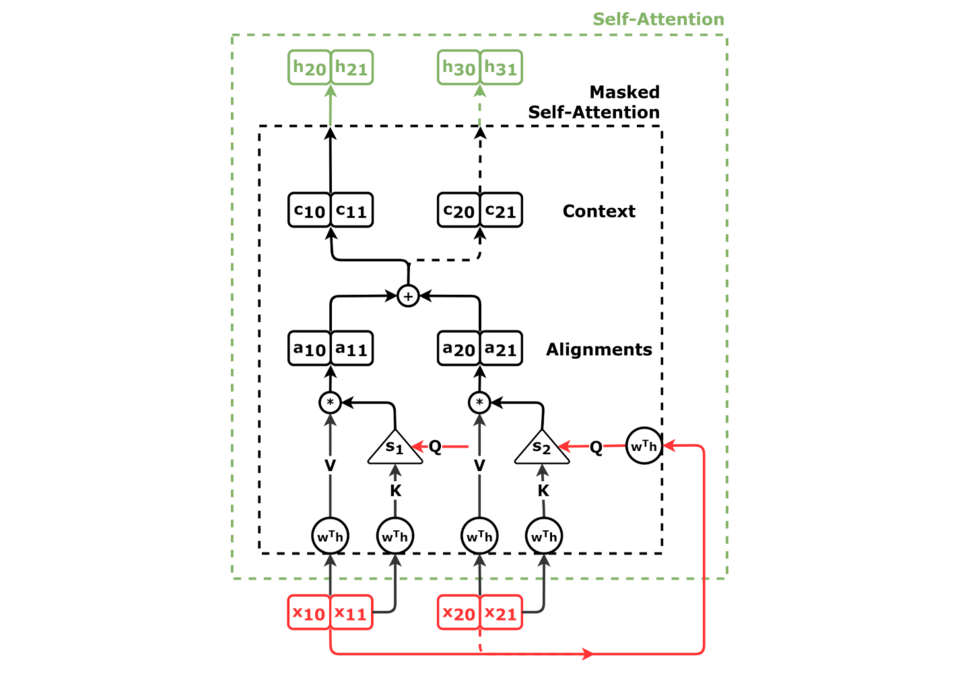
🕸️ 网络配图(Wikimedia Commons)
📷 来源:Wikimedia Commons · dvgodoy · CC BY 4.0
总览对比表¶
| 变种 | KV 头数 | 每 token 缓存 | 显存/速度 | 代表模型 |
|---|---|---|---|---|
| MHA | h(=Q 头数) | 2·h·d_k 每组 | 基准 | 原始 Transformer、BERT |
| MQA | 1 | 2·d_k | 缓存最省,质量略降 | PaLM、Falcon-7B |
| GQA | g(0<g<h) | 2·g·d_k | 缓存省 g/h,质量近 MHA | MiniMind(4/8)、LLaMA2-70B、DeepSeek |
| 滑动窗口 | h | 2·h·d_k | 每 token 只算 w 个 key,$O(Nw)$ | Mistral |
| Flash | h | 2·h·d_k | 显存 $O(N)$(分块) | GPT 系列训练标配 |
动机主线:长上下文时代,KV 缓存与注意力矩阵的显存成为瓶颈 → 要么少存 KV(MQA/GQA),要么少算(滑动窗口),要么省显存(Flash)。
导入与统一简版注意力¶
超参:$B=2,\ T=8,\ d_{model}=32,\ h=8$ 个 Q 头、$d_k=4$;种子 0。 手搓纯 NumPy forward(结构教学重点),torch 侧手动实现同一逻辑做数值对比。
# ---- matplotlib 中文字体(防图内中文乱码)----
import matplotlib
matplotlib.rcParams['font.sans-serif'] = ['Microsoft YaHei', 'SimHei', 'Songti SC', 'Arial Unicode MS', 'DejaVu Sans']
matplotlib.rcParams['axes.unicode_minus'] = False
# -------------------------------------------
import numpy as np
import torch
import torch.nn.functional as F
import math

np.random.seed(0)
torch.manual_seed(0)

def softmax_rows(x):
    """数值稳定 softmax(沿最后一维 key 方向)。"""
    x = x - np.max(x, axis=-1, keepdims=True)
    ex = np.exp(x)
    return ex / np.sum(ex, axis=-1, keepdims=True)

def np_attention(Q, K, V, mask=None):
    """单头缩放点积注意力:Q,K,V [B,T,d_k];mask 为 True 处填 -inf。"""
    dk = Q.shape[-1]
    scores = np.matmul(Q, K.swapaxes(-1, -2)) / math.sqrt(dk)
    if mask is not None:
        scores = np.where(mask, -np.inf, scores)
    attn = softmax_rows(scores)
    return np.matmul(attn, V), attn

def split_heads(x, h, d_k):
    """[B,T,d] -> [B,h,T,d_k]。"""
    B, T, d = x.shape
    return x.reshape(B, T, h, d_k).transpose(0, 2, 1, 3)

def merge_heads(heads):
    """h 个 [B,T,d_k] -> [B,T,d]。"""
    return np.concatenate(heads, axis=-1)
变种一:标准多头 MHA(回顾)¶
每个 Q 头配一组 K/V 头(h 组)。KV 缓存内存:每生成 1 个 token 要存 $2 \times h \times d_k$ 个浮点数(每个头各存一份 K 和 V),随层数和头数线性增长。
手搓:Wq, Wk, Wv: [d, d](8 头共用投影),拆头后逐头注意力,拼接 + Wo 投影。
def np_mha(x, Wq, Wk, Wv, Wo, bq, bk, bv, bo, h, d_k, mask=None):
    """标准 MHA:h 组 Q/K/V。x [B,T,d],返回 out [B,T,d] 与 attn_all [B,h,T,T]。"""
    B, T, d = x.shape
    Q = split_heads(x @ Wq + bq, h, d_k)   # [B,h,T,d_k]
    K = split_heads(x @ Wk + bk, h, d_k)
    V = split_heads(x @ Wv + bv, h, d_k)
    heads, attn_all = [], np.zeros((B, h, T, T))
    for i in range(h):
        o, a = np_attention(Q[:, i], K[:, i], V[:, i], mask)
        heads.append(o); attn_all[:, i] = a
    return merge_heads(heads) @ Wo + bo, attn_all

# ---------- 与 torch 手动同逻辑对比 ----------
B, T, d, h, d_k = 2, 8, 32, 8, 4     # d = h*d_k = 8*4 = 32
x_np = np.random.randn(B, T, d)
Wq = np.random.randn(d, d) * 0.05; bq = np.random.randn(d) * 0.05
Wk = np.random.randn(d, d) * 0.05; bk = np.random.randn(d) * 0.05
Wv = np.random.randn(d, d) * 0.05; bv = np.random.randn(d) * 0.05
Wo = np.random.randn(d, d) * 0.05; bo = np.random.randn(d) * 0.05

out_np, attn_np = np_mha(x_np, Wq, Wk, Wv, Wo, bq, bk, bv, bo, h, d_k)

xt = torch.tensor(x_np, dtype=torch.float64)
def tsplit(x, h, d_k):
    """torch 版拆头:与 numpy split_heads 对应。"""
    B, T, d = x.shape
    return x.reshape(B, T, h, d_k).permute(0, 2, 1, 3)
Q = tsplit(xt @ torch.tensor(Wq, dtype=torch.float64) + torch.tensor(bq, dtype=torch.float64), h, d_k)
K = tsplit(xt @ torch.tensor(Wk, dtype=torch.float64) + torch.tensor(bk, dtype=torch.float64), h, d_k)
V = tsplit(xt @ torch.tensor(Wv, dtype=torch.float64) + torch.tensor(bv, dtype=torch.float64), h, d_k)
scores = torch.matmul(Q, K.transpose(-2, -1)) / math.sqrt(d_k)
attn_t = F.softmax(scores, dim=-1)
heads_t = torch.matmul(attn_t, V)                      # [B,h,T,d_k]
concat_t = heads_t.transpose(1, 2).reshape(B, T, d)    # 拼回
out_t = concat_t @ torch.tensor(Wo, dtype=torch.float64) + torch.tensor(bo, dtype=torch.float64)
e1 = float((out_t.detach().numpy() - out_np).max())
assert np.allclose(out_np, out_t.detach().numpy(), rtol=1e-4, atol=1e-6)
print(f'1) MHA  forward :  max abs err = {e1:.3e}   ->  PASS')
print('   KV 缓存/token =', 2 * h * d_k, '个浮点数/层')
1) MHA  forward :  max abs err = 2.776e-17   ->  PASS
   KV 缓存/token = 64 个浮点数/层
变种二:MQA(Multi-Query Attention)¶
所有 Q 头共享同一组 K/V(1 个 KV 头),论文《Fast Transformer Decoding》(Shazeer 2019)。 KV 缓存从 $2hd_k$ 降到 $2d_k$——缓存最省;代价是不同头的 K/V 相同,表达力略降。
手搓:K/V 投影只有 1 个头 [d, d_k],算注意力前把 K/V 复制 8 份到每个 Q 头。
def np_mqa(x, Wq, Wk, Wv, Wo, bq, bk, bv, bo, h, d_k, mask=None):
    """MQA:K/V 只有 1 组,repeat 到 h 个 Q 头。Wk,Wv: [d, d_k]。"""
    B, T, d = x.shape
    Q = split_heads(x @ Wq + bq, h, d_k)              # [B,h,T,d_k] 8 组
    K1 = (x @ Wk + bk)[:, None]                       # [B,1,T,d_k] 1 组
    V1 = (x @ Wv + bv)[:, None]
    K = np.repeat(K1, h, axis=1)                      # repeat -> [B,h,T,d_k]
    V = np.repeat(V1, h, axis=1)
    heads, attn_all = [], np.zeros((B, h, T, T))
    for i in range(h):
        o, a = np_attention(Q[:, i], K[:, i], V[:, i], mask)
        heads.append(o); attn_all[:, i] = a
    return merge_heads(heads) @ Wo + bo, attn_all

# ---------- torch 对比(同样 repeat) ----------
Wq = np.random.randn(d, d) * 0.05; bq = np.random.randn(d) * 0.05
Wk = np.random.randn(d, d_k) * 0.05; bk = np.random.randn(d_k) * 0.05
Wv = np.random.randn(d, d_k) * 0.05; bv = np.random.randn(d_k) * 0.05
Wo = np.random.randn(d, d) * 0.05; bo = np.random.randn(d) * 0.05

out_np, attn_np = np_mqa(x_np, Wq, Wk, Wv, Wo, bq, bk, bv, bo, h, d_k)
Q = tsplit(xt @ torch.tensor(Wq, dtype=torch.float64) + torch.tensor(bq, dtype=torch.float64), h, d_k)
K1 = (xt @ torch.tensor(Wk, dtype=torch.float64) + torch.tensor(bk, dtype=torch.float64)).unsqueeze(1)
V1 = (xt @ torch.tensor(Wv, dtype=torch.float64) + torch.tensor(bv, dtype=torch.float64)).unsqueeze(1)
K = K1.expand(-1, h, -1, -1); V = V1.expand(-1, h, -1, -1)
scores = torch.matmul(Q, K.transpose(-2, -1)) / math.sqrt(d_k)
attn_t = F.softmax(scores, dim=-1)
out_t = (torch.matmul(attn_t, V).transpose(1, 2).reshape(B, T, d)
         @ torch.tensor(Wo, dtype=torch.float64) + torch.tensor(bo, dtype=torch.float64))
e2 = float((out_t.detach().numpy() - out_np).max())
assert np.allclose(out_np, out_t.detach().numpy(), rtol=1e-4, atol=1e-6)
print(f'2) MQA  forward :  max abs err = {e2:.3e}   ->  PASS')
print('   KV 缓存/token =', 2 * d_k, '个浮点数/层(比 MHA 省', 8, '倍)')
2) MQA  forward :  max abs err = 2.776e-17   ->  PASS
   KV 缓存/token = 8 个浮点数/层(比 MHA 省 8 倍)
变种三:GQA(Grouped-Query Attention)—— 教学重点¶
GQA(Ainslie et al. 2023)是 MHA 与 MQA 的折中:h 个 Q 头分成 g 组,每组共享一组 K/V。
- $g=h$ 退化为 MHA;$g=1$ 退化为 MQA
- 缓存省 $g/h$,质量几乎不降(每组的 K/V 仍服务多个 Q 头,但比 MQA 灵活得多)
MiniMind 的 Attention 就是 GQA:num_attention_heads=8, num_key_value_heads=4,
即 8 个 Q 头、4 个 KV 头(n_rep = 8/4 = 2,每个 KV 头服务 2 个 Q 头)。
手搓:Wk,Wv: [d, g*d_k](4 组),拆成 4 个头后每个 repeat n_rep 次对齐到 8 个 Q 头。
✍️ §3.1 手算 GQA:参数/缓存账本 + 2 个 token 的共享 K/V 前向¶
GQA 用 $g$ 组 K/V 服务 $h$ 个 Q 头——先算账(省多少参数/缓存),再手算"头 0、头 1 共用同一组 K/V"的前向。
一、账本:h=8、g=2、d_k=64、d=512¶
KV 投影参数量(每层,$W_k,W_v$ 各一份)与每 token 缓存(每层,$n_{kv}$ 为 KV 头数):
| 变种 | KV 参数量 $2\cdot n_{kv}\cdot d\cdot d_k$ | 每 token 缓存 $2\cdot n_{kv}\cdot d_k$ |
|---|---|---|
| MHA($n_{kv}=8$) | $2\times8\times512\times64=524\,288$ | $2\times8\times64=1024$ |
| GQA($n_{kv}=2$) | $2\times2\times512\times64=131\,072$ | $2\times2\times64=256$ |
| MQA($n_{kv}=1$) | $2\times1\times512\times64=65\,536$ | $2\times1\times64=128$ |
比例 MHA:GQA:MQA = 8:2:1:GQA 比 MHA 省 $8/2=4$ 倍(参数与缓存同比例)。
二、前向:h=4、g=2、d_k=1,共享 K/V¶
设定:$d_{model}=4$,4 个 Q 头分 2 组($n_{rep}=h/g=2$,每组服务 2 个头),$d_k=1$($\sqrt{d_k}=1$,免缩放);投影取最简(q 每头取一个维度、k/v 取固定系数组合),$b=0,\ W_o=I$:
$$x_1=[1.0,\ 0.5,\ 0.5,\ 1.0],\qquad x_2=[0.5,\ 1.0,\ 1.0,\ 0.5]$$
| 头/组 | q(token1, token2) | 组 K(token1, token2) | 组 V(token1, token2) |
|---|---|---|---|
| 头 0(组 0) | $(1.0,\ 0.5)$ | — | — |
| 头 1(组 0) | $(0.5,\ 1.0)$ | — | — |
| 组 0 K/V(头 0、1 共用) | $k^0=(2.0,\ 1.0)$ | $v^0=(1.0,\ 2.0)$ | |
| 头 2(组 1) | $(0.5,\ 1.0)$ | — | — |
| 头 3(组 1) | $(1.0,\ 0.5)$ | — | — |
| 组 1 K/V(头 2、3 共用) | $k^1=(1.0,\ 2.0)$ | $v^1=(3.0,\ 1.5)$ |
第 1 步:头 0(用组 0 的 K/V)——分数 $s_t=q\cdot k^0_t$
$$s=[1.0\times2.0,\ 1.0\times1.0]=[2.0,\ 1.0]$$
$$\text{softmax}([2,1])=\frac{[e^2,e^1]}{e^2+e^1}=\frac{[7.3891,\ 2.7183]}{10.1074}=[0.7311,\ 0.2689]$$
$$\text{out}_0=0.7311\times1.0+0.2689\times2.0=0.7311+0.5378=1.2689$$
第 2 步:头 1(仍然用组 0 的同一组 K/V)——共享体现在"K/V 只算一次,两个头拿去用"
$$s=[0.5\times2.0,\ 0.5\times1.0]=[1.0,\ 0.5],\qquad w=\frac{[2.7183,\ 1.6487]}{4.3670}=[0.6225,\ 0.3775]$$
$$\text{out}_1=0.6225\times1.0+0.3775\times2.0=0.6225+0.7550=1.3775$$
**第 3 步:头 2、3(组 1)**与 token1 全部头的输出汇总:
| 头 | 组 | $s=[s_1,s_2]$ | softmax 权重 | 输出(token1) |
|---|---|---|---|---|
| 0 | 组 0 | $[2.0,\ 1.0]$ | $[0.7311,\ 0.2689]$ | $1.2689$ |
| 1 | 组 0 | $[1.0,\ 0.5]$ | $[0.6225,\ 0.3775]$ | $1.3775$ |
| 2 | 组 1 | $[0.5,\ 1.0]$ | $[0.3775,\ 0.6225]$ | $2.0663$ |
| 3 | 组 1 | $[1.0,\ 2.0]$ | $[0.2689,\ 0.7311]$ | $1.9034$ |
第 4 步:拼接($W_o=I$)
$$\text{GQA}(x_1)=[1.2689,\ 1.3775,\ 2.0663,\ 1.9034]$$
手算收获:
- 头 0、头 1 的分数/输出不同,唯一的差异来源是各自的 Q 投影——k、v 完全共用同一组数(组 0 只算一次 K/V)
- $n_{kv}$ 从 8 → 2 → 1,参数与缓存按 $8:2:1$ 缩放:GQA 是"质量接近 MHA、缓存接近 MQA"的折中($g$ 越大越接近 MHA)
- 每 token 缓存 = $2\cdot n_{kv}\cdot d_k$:长上下文下 $g$ 减半 → 缓存减半(如 MiniMind 8 Q 头 / 4 KV 头)
- 若 $g=4$(即 h=g)就退化成 MHA、$g=1$ 退化成 MQA——GQA 是两者的统一框架(见 notebook 的 np_gqa:
repeat对齐 Q 头)
下面 numpy 复算。
# ---- §3.1 验证:numpy 复算 GQA 账本 + 共享 K/V 前向 ----
import numpy as np

# ---- 一、账本:h=8, g=2, d_k=64, d=512 ----
h8, g8, d_k8, d8 = 8, 2, 64, 512
params = {'MHA': 2 * h8 * d8 * d_k8, 'GQA': 2 * g8 * d8 * d_k8, 'MQA': 2 * 1 * d8 * d_k8}
cache  = {'MHA': 2 * h8 * d_k8, 'GQA': 2 * g8 * d_k8, 'MQA': 2 * 1 * d_k8}
print('KV 参数量/层 =', params, '  每 token 缓存 =', cache)
assert params['MHA'] == 524288 and params['GQA'] == 131072 and params['MQA'] == 65536
assert cache['MHA'] == 1024 and cache['GQA'] == 256 and cache['MQA'] == 128

# ---- 二、前向:h=4, g=2, d_k=1,组内共享 K/V ----
X = np.array([[1.0, 0.5, 0.5, 1.0],      # token1
              [0.5, 1.0, 1.0, 0.5]])     # token2
Q = np.array([[1.0, 0.5], [0.5, 1.0], [0.5, 1.0], [1.0, 0.5]])  # 4 头 q(t1,t2)
K = [np.array([2.0, 1.0]), np.array([2.0, 1.0]),   # 组0 的 k(头0、1 共用)
     np.array([1.0, 2.0]), np.array([1.0, 2.0])]   # 组1 的 k(头2、3 共用)
V = [np.array([1.0, 2.0]), np.array([1.0, 2.0]),
     np.array([3.0, 1.5]), np.array([3.0, 1.5])]

def softmax1d(z):
    e = np.exp(z - z.max())
    return e / e.sum()

heads = []
for i in range(4):
    s = Q[i][:, None] * K[i]                       # [T,T] 分数(d_k=1 免缩放)
    w = np.array([softmax1d(s[t]) for t in range(2)])
    out = w @ V[i]                                 # [T]
    heads.append(out)
    print(f'head{i}(组{i//2}): s(t1)={np.round(s[0],4)} w(t1)={np.round(w[0],4)} out(t1)={out[0]:.4f}')
out_all = np.stack(heads, axis=-1).reshape(2, 4)   # Wo=I → [T, d=4]
print('token1 输出 =', np.round(out_all[0], 4))
print('token2 输出 =', np.round(out_all[1], 4))
assert np.allclose(out_all[0], [1.2689, 1.3775, 2.0663, 1.9034], atol=1e-3)
assert np.allclose(out_all[1], [1.3775, 1.2689, 1.9034, 2.0663], atol=1e-3)
print('\n✓ 与手算一致:GQA 共享 K/V 前向数值吻合')
def np_gqa(x, Wq, Wk, Wv, Wo, bq, bk, bv, bo, h, g, d_k, mask=None):
    """GQA:h 个 Q 头、g 个 KV 头,每个 KV 头 repeat n_rep=h/g 次。
    Wq: [d,d];Wk,Wv: [d, g*d_k]。"""
    B, T, d = x.shape
    n_rep = h // g                                     # 每个 KV 头服务的 Q 头数
    Q = split_heads(x @ Wq + bq, h, d_k)               # [B,h,T,d_k]
    K = split_heads(x @ Wk + bk, g, d_k)               # [B,g,T,d_k]
    V = split_heads(x @ Wv + bv, g, d_k)
    K = np.repeat(K, n_rep, axis=1)                    # [B,g*2=h,T,d_k](每个 KV 头相邻复制 2 份)
    V = np.repeat(V, n_rep, axis=1)
    heads, attn_all = [], np.zeros((B, h, T, T))
    for i in range(h):
        o, a = np_attention(Q[:, i], K[:, i], V[:, i], mask)
        heads.append(o); attn_all[:, i] = a
    return merge_heads(heads) @ Wo + bo, attn_all

# ---------- torch 对比(torch 用 repeat_interleave,语义与 np.repeat 一致) ----------
g = 4
Wq = np.random.randn(d, d) * 0.05; bq = np.random.randn(d) * 0.05
Wk = np.random.randn(d, g * d_k) * 0.05; bk = np.random.randn(g * d_k) * 0.05
Wv = np.random.randn(d, g * d_k) * 0.05; bv = np.random.randn(g * d_k) * 0.05
Wo = np.random.randn(d, d) * 0.05; bo = np.random.randn(d) * 0.05

out_np, attn_np = np_gqa(x_np, Wq, Wk, Wv, Wo, bq, bk, bv, bo, h, g, d_k)
Q = tsplit(xt @ torch.tensor(Wq, dtype=torch.float64) + torch.tensor(bq, dtype=torch.float64), h, d_k)
K = tsplit(xt @ torch.tensor(Wk, dtype=torch.float64) + torch.tensor(bk, dtype=torch.float64), g, d_k)
V = tsplit(xt @ torch.tensor(Wv, dtype=torch.float64) + torch.tensor(bv, dtype=torch.float64), g, d_k)
n_rep = h // g
K = K.repeat_interleave(n_rep, dim=1)                  # [B,h,T,d_k] 与手搓一致
V = V.repeat_interleave(n_rep, dim=1)
scores = torch.matmul(Q, K.transpose(-2, -1)) / math.sqrt(d_k)
attn_t = F.softmax(scores, dim=-1)
out_t = (torch.matmul(attn_t, V).transpose(1, 2).reshape(B, T, d)
         @ torch.tensor(Wo, dtype=torch.float64) + torch.tensor(bo, dtype=torch.float64))
e3 = float((out_t.detach().numpy() - out_np).max())
assert np.allclose(out_np, out_t.detach().numpy(), rtol=1e-4, atol=1e-6)
print(f'3) GQA  forward :  max abs err = {e3:.3e}   ->  PASS')
print('   KV 缓存/token =', 2 * g * d_k, '(MiniMind: 8 Q 头 / 4 KV 头,n_rep=2)')
3) GQA  forward :  max abs err = 2.776e-17   ->  PASS
   KV 缓存/token = 32 (MiniMind: 8 Q 头 / 4 KV 头,n_rep=2)
变种四:滑动窗口注意力(Sliding Window Attention)¶
Mistral 用:每个 query 只看窗口 w 内的 key(自己 + 左侧 w-1 个),右侧和远处的 key 全部屏蔽。 每 token 计算量从 $O(T)$ 降到 $O(w)$(常数),长序列可流式推理;代价是"看不见太远的历史" (实际靠多层堆叠间接扩大感受野)。
实现:把注意力 mask 从"上三角因果"换成"因果 + 窗口 band"(对角线附近为 True 之外全 True)。
def swa_mask(T, w):
    """滑动窗口 + 因果掩码:True 表示要屏蔽的位置。
    band:|i-j| <= w-1 且 i>=j 允许,其余(未来 或 太远的历史)屏蔽。"""
    i_idx = np.arange(T)[:, None]
    j_idx = np.arange(T)[None, :]
    causal = i_idx < j_idx                 # 未来位置屏蔽
    far = (i_idx - j_idx) >= w             # 超出窗口左侧的历史屏蔽
    return causal | far

w = 4
mask_swa = swa_mask(T, w)
# 重新生成一套 MHA 全尺寸权重(前几个 cell 的 Wk/Wv 被 MQA/GQA 改成了 [d, d_k]/[d, g*d_k])
Wq = np.random.randn(d, d) * 0.05; bq = np.random.randn(d) * 0.05
Wk = np.random.randn(d, d) * 0.05; bk = np.random.randn(d) * 0.05
Wv = np.random.randn(d, d) * 0.05; bv = np.random.randn(d) * 0.05
Wo = np.random.randn(d, d) * 0.05; bo = np.random.randn(d) * 0.05
# 手搓:MHA + 窗口掩码
out_np, attn_np = np_mha(x_np, Wq, Wk, Wv, Wo, bq, bk, bv, bo, h, d_k, mask=mask_swa)
# torch 同逻辑
Q = tsplit(xt @ torch.tensor(Wq, dtype=torch.float64) + torch.tensor(bq, dtype=torch.float64), h, d_k)
K = tsplit(xt @ torch.tensor(Wk, dtype=torch.float64) + torch.tensor(bk, dtype=torch.float64), h, d_k)
V = tsplit(xt @ torch.tensor(Wv, dtype=torch.float64) + torch.tensor(bv, dtype=torch.float64), h, d_k)
scores = torch.matmul(Q, K.transpose(-2, -1)) / math.sqrt(d_k)
scores = scores.masked_fill(torch.tensor(mask_swa), -torch.inf)
attn_t = F.softmax(scores, dim=-1)
out_t = (torch.matmul(attn_t, V).transpose(1, 2).reshape(B, T, d)
         @ torch.tensor(Wo, dtype=torch.float64) + torch.tensor(bo, dtype=torch.float64))
e4 = float((out_t.detach().numpy() - out_np).max())
assert np.allclose(out_np, out_t.detach().numpy(), rtol=1e-4, atol=1e-6)
print(f'4) SWA forward :  max abs err = {e4:.3e}   ->  PASS')
print('   每个 query 只计算', w, '个 key(T=8 时比全注意力省', f'{8/w:.0f}', '倍计算)')
4) SWA forward :  max abs err = 2.776e-17   ->  PASS
   每个 query 只计算 4 个 key(T=8 时比全注意力省 2 倍计算)
变种五:Flash Attention(概念 + 数值等价验证)¶
动机:标准注意力要先把 scores[B,h,T,T] 完整落显存($O(N^2)$),长序列直接爆显存。
Flash Attention(Dao et al. 2022)把 $T$ 维分块(如 $64\times 64$),
每个块做"在线 softmax":维护运行最大 $m$ 和运行分母 $l$,每来一个块就重归一化:
$$m \leftarrow \max(m, \mathrm{rowmax}(s_{block})),\qquad l \leftarrow l\,e^{m_{old}-m} + e^{s_{block}-m},\qquad O \leftarrow O\,e^{m_{old}-m} + \frac{e^{s_{block}-m}}{l}V_{block}$$
这样显存只要 $O(N)$(只存输出,不存完整 scores),还能融合 kernel。 数学上分块 softmax 与全局 softmax 严格等价——下面用 NumPy 验证这一点(精度 ~1e-7)。
def flash_attn_chunked(Q, K, V, mask=None, block=2):
    """分块在线 softmax 注意力(数值等价性演示版,单头)。
    Q,K,V: [B,T,d_k];返回 out(显存友好的分块计算路径)。"""
    B, T, dk = Q.shape
    scores = np.matmul(Q, K.swapaxes(-1, -2)) / math.sqrt(dk)   # 教学演示仍算全 scores 便于对比
    if mask is not None:
        scores = np.where(mask, -np.inf, scores)
    out = np.zeros_like(Q)
    m = np.full((B, T), -np.inf)        # 每个 query 行的运行最大值
    l = np.zeros((B, T))                # 运行分母(softmax 归一化常数)
    for s in range(0, T, block):
        s_end = s + block
        s_block = scores[:, :, s:s_end]                 # [B,T,block] 当前块
        m_old, l_old = m, l
        m_new = np.maximum(m, s_block.max(axis=-1))     # 更新行最大值
        scale = np.exp(m_old - m_new)                   # 旧行的重缩放因子 e^(m_old−m_new)
        with np.errstate(divide='ignore', invalid='ignore'):
            p = np.exp(s_block - m_new[:, :, None])     # 块内 exp(减新最大值)
            p_sum = p.sum(axis=-1)
            l = l_old * scale + p_sum                   # 分母:旧项重缩放 + 新块
            out = out * (scale * l_old / l)[:, :, None] + (p @ V[:, s:s_end]) / l[:, :, None]
        m = m_new
    return out

# ---- 等价性验证:分块 vs 标准 ----
def np_attention_std(Q, K, V, mask=None):
    scores = np.matmul(Q, K.swapaxes(-1, -2)) / math.sqrt(dk_)
    if mask is not None:
        scores = np.where(mask, -np.inf, scores)
    attn = softmax_rows(scores)
    return np.matmul(attn, V)

dk_ = 4
Q = np.random.randn(2, 8, dk_); K = np.random.randn(2, 8, dk_); V = np.random.randn(2, 8, dk_)
causal = np.triu(np.ones((8, 8)), 1).astype(bool)
out_flash = flash_attn_chunked(Q, K, V, mask=causal, block=2)     # 4 个块
out_std = np_attention_std(Q, K, V, mask=causal)
e5 = float(np.abs(out_flash - out_std).max())
assert np.allclose(out_flash, out_std, rtol=1e-5, atol=1e-6)
print(f'5) Flash(分块) vs 标准 softmax :  max abs err = {e5:.3e}   ->  PASS')
print('   分块在线 softmax 与全局 softmax 数学等价,显存从 O(T²) 降到 O(T)')
5) Flash(分块) vs 标准 softmax :  max abs err = 3.331e-16   ->  PASS
   分块在线 softmax 与全局 softmax 数学等价,显存从 O(T²) 降到 O(T)
可视化:头映射与掩码模式¶
%matplotlib inline
import matplotlib.pyplot as plt
import numpy as np
plt.rcParams['font.sans-serif'] = ['Microsoft YaHei', 'SimHei', 'DejaVu Sans']
plt.rcParams['axes.unicode_minus'] = False

# ---- 图1:MHA / MQA / GQA 的 Q→KV 头映射 ----
fig, axes = plt.subplots(1, 3, figsize=(12, 3.6))
schemes = [
    ('MHA:8 Q 头 = 8 KV 头', [i for i in range(8)], 'MHA'),
    ('MQA:8 Q 头 → 1 KV 头', [0] * 8, 'MQA'),
    ('GQA:8 Q 头 → 4 KV 头', [i // 2 for i in range(8)], 'GQA'),
]
for ax, (title, kv_of_q, tag) in zip(axes, schemes):
    for qi in range(8):
        ax.add_patch(plt.Rectangle((qi * 0.9, 2.2), 0.8, 0.9, fc='#4C72B0', ec='k'))
        ax.text(qi * 0.9 + 0.4, 2.65, f'Q{qi}', ha='center', va='center', fontsize=8, color='white')
    for ki in sorted(set(kv_of_q)):
        ax.add_patch(plt.Rectangle((ki * 0.9, 0.6), 0.8, 0.9, fc='#55A868', ec='k'))
        ax.text(ki * 0.9 + 0.4, 1.05, f'KV{ki}', ha='center', va='center', fontsize=8, color='white')
    for qi in range(8):
        ki = kv_of_q[qi]
        ax.annotate('', xy=(ki * 0.9 + 0.4, 1.5), xytext=(qi * 0.9 + 0.4, 2.2),
                    arrowprops=dict(arrowstyle='->', color='#888', lw=1.0))
    ax.set_xlim(-0.3, 7.6); ax.set_ylim(0, 3.4); ax.axis('off')
    ax.set_title(title, fontsize=11)
plt.tight_layout(); plt.show()

# ---- 图2:滑动窗口掩码矩阵 ----
fig, ax = plt.subplots(figsize=(4.6, 4.2))
im = ax.imshow(~mask_swa, cmap='YlOrRd', vmin=0, vmax=1)
ax.set_xticks(range(T)); ax.set_yticks(range(T))
ax.set_xticklabels([f'k{j}' for j in range(T)])
ax.set_yticklabels([f'q{i}' for i in range(T)])
ax.set_title(f'滑动窗口掩码(w={w},黄=允许)', fontsize=11)
plt.tight_layout(); plt.show()

# ---- 图3:四种注意力的"允许位置"模式对比 ----
fig, axes = plt.subplots(1, 4, figsize=(14, 3.8))
modes = [
    ('全注意力', np.zeros((T, T), dtype=bool)),
    ('因果掩码', np.triu(np.ones((T, T)), 1).astype(bool)),
    ('滑动窗口 w=4', mask_swa),
    ('局部窗口(双向)', ~(np.abs(np.arange(T)[:, None] - np.arange(T)[None, :]) < 2)),
]
for ax, (t, m) in zip(axes, modes):
    ax.imshow(~m, cmap='YlOrRd', vmin=0, vmax=1)
    ax.set_xticks([]); ax.set_yticks([])
    ax.set_title(t, fontsize=11)
fig.suptitle('图3  注意力模式对比:黄 = 允许 query i 看 key j', fontsize=12)
plt.tight_layout(); plt.show()


综合对比与总结¶
| 变种 | 一句话 | KV 头数 | 代价/收益 |
|---|---|---|---|
| MHA | 每 Q 头配 K/V | h | 质量基准,缓存大 |
| MQA | 全部 Q 共享 K/V | 1 | 缓存最小,质量略降 |
| GQA | 分组共享 K/V | g | 缓存省 g/h,质量近 MHA |
| SWA | 只看窗口 w | h | 计算 $O(Nw)$,视野受限 |
| Flash | 分块在线 softmax | h | 显存 $O(N)$,数值等价 |
minLLM 对应位置:model/model_minimind.py 的 Attention 类正是 GQA:
num_attention_heads=8 / num_key_value_heads=4,n_rep = 8//4 = 2,
用 repeat_interleave 复制 KV 头;flash_attn=True 时用 F.scaled_dot_product_attention(内部就是 Flash Attention)。
LLaMA2-70B 用 GQA(8/1 近似 MQA)、Mistral 用滑动窗口 + GQA、DeepSeek-V2 用 MLA(多头潜在注意力,GQA 的进阶版)。