23. 知识蒸馏 —— 软标签 · 温度 · 学生-教师实验(手搓)¶
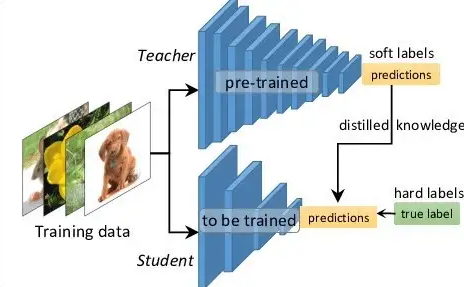
蒸馏(Distillation, Hinton et al. 2015):用一个又大又准的 teacher 教一个小的 student。 不是直接抄答案(硬标签),而是抄 teacher 的置信度分布(软标签)——"猫"和"狗"之间的相似度 这种暗知识,硬标签里没有,软标签里有。
本讲:
- 公式:带温度 $T$ 的软标签与 KL 蒸馏损失
- 手搓:KL 蒸馏损失(含 $T^2$ 缩放)并与数值核对
- 实验:teacher(大) → student(小),对比"硬标签训练" vs "蒸馏训练",并扫描温度 $T$
核心概念¶
(a) 🗂️ 知识蒸馏:用小模型偷师大模型¶
用大而准的 teacher 产出温度软化的软标签来教小 student:损失 = T²·KL(teacher‖student) + 硬标签 CE,做温度扫描验证蒸馏效果并对照 minLLM train_distillation.py。
flowchart TB
    A["💡 蒸馏思想<br/>teacher 教 student"] --> B["🏷️ 软标签<br/>温度 T 下 softmax"]
    D["🎓 Teacher 大模型<br/>64 隐藏训得好"] --> B
    B --> C["⚖️ 蒸馏损失<br/>T²·KL + 硬标签 CE"]
    C --> E["📚 Student 两种学法<br/>硬标签 vs 软标签"]
    E --> F["🌡️ 温度扫描<br/>T=1/2/4/8 对比"]
    F --> G["🏭 生产对照<br/>train_distillation.py"]
- 💡 蒸馏思想:用一个又大又准的 teacher 教一个小的 student(Hinton et al. 2015)。
- 🏷️ 软标签:teacher 在温度 T 下的 softmax 输出概率分布,携带类间关系信息。
- 🎓 Teacher 大模型:32 维输入→10 类任务上,64 隐藏单元大模型训 800 步学得很好。
- ⚖️ 蒸馏损失:T²·KL(p_t^T ‖ p_s^T) + 硬标签 CE,T² 补偿温度下的梯度尺度。
- 📚 Student 两种学法:小模型(16 隐藏)对比纯硬标签 CE 与软标签蒸馏的学习效果。
- 🌡️ 温度扫描:T=1/2/4/8 各训一个蒸馏学生,看温度对精度的作用。
- 🏭 生产对照:与 minLLM train_distillation.py 的伪代码逐行对应。
🕸️ 网络配图(Wikimedia Commons)
📷 来源:Wikimedia Commons · Prakhar Ganesh · CC0
1. 公式¶
软标签(temperature $T$ 下的 softmax):
$$p_i^{(T)} = \frac{\exp(z_i / T)}{\sum_j \exp(z_j / T)}$$
$T$ 越大分布越"软"——把 teacher 对"相似类"的犹豫也传给学生。
蒸馏损失($\alpha$ 控制硬/软比例,$T^2$ 是为了让梯度量级与 T 无关):
$$\mathcal{L} = \alpha\cdot \mathrm{CE}(z_s, y_{\text{hard}}) + (1-\alpha)\cdot T^2\cdot \mathrm{KL}\big(p^{(T)}_t \,\|\, p^{(T)}_s\big)$$
KL 散度:$\mathrm{KL}(P\|Q)=\sum_i P_i\log\dfrac{P_i}{Q_i}$(teacher 的分布当"真值")。
✍️ §1.1 手算知识蒸馏:一个 teacher 的软标签,怎么教学生¶
蒸馏损失 $L=(1-\alpha)\text{CE}(y,q)+\alpha T^2\text{KL}(p^T,q^T)$——手算一组 logits,看懂"软标签"和 $T^2$ 的来源。
设定:teacher logits $z_t=(2.0,1.0,0.1)$,student logits $z_s=(0.8,0.9,0.2)$,温度 $T=4$。
第 1 步:teacher 的软标签($z/T=(0.50,0.25,0.025)$)
$$p^{T}=\text{softmax}(z_t/4)=\left[\frac{e^{0.5}}{3.958},\ \frac{e^{0.25}}{3.958},\ \frac{e^{0.025}}{3.958}\right]=[0.4165,\ 0.3244,\ 0.2590]$$
第 2 步:student 的软分布($z_s/4=(0.2,0.225,0.05)$)
$$q^{T}=[0.3465,\ 0.3553,\ 0.2982]$$
第 3 步:KL 散度
$$\text{KL}=\sum_i p_i\ln\frac{p_i}{q_i}=0.4165\ln\tfrac{0.4165}{0.3465}+0.3244\ln\tfrac{0.3244}{0.3553}+0.2590\ln\tfrac{0.2590}{0.2982}=0.0767-0.0295-0.0365=0.0107$$
蒸馏项 $=T^2\text{KL}=16\times0.0107=0.1716$,乘 $\alpha$ 后与硬标签 CE 相加。
手算收获:
- 硬标签 $\text{softmax}(z_t)\approx[0.659,0.242,0.099]$:词 2、3 的"尾巴"信息被压没;软标签 $[0.4165,0.3244,0.2590]$ 把"词 2、3 其实有点接近"的类间相似度传给了学生
- $T^2=16$ 的来历:$\text{KL}$ 的梯度对 logits 是 $O(1/T^2)$ 的,乘回 $T^2$ 让蒸馏项的梯度尺度与温度无关
- student 的软分布要尽量贴近 teacher:若 $q=p$,KL=0,蒸馏项为零——"向 teacher 看齐"的度量就是 KL
- 学生只见过软标签也能学:软标签含 >1 bit 信息(相似度结构),硬标签只有 1 bit(是哪一类)
下面 numpy 复算。
# ---- §1.1 验证:numpy 复算软标签蒸馏 ----
import numpy as np

zt = np.array([2.0, 1.0, 0.1])
zs = np.array([0.8, 0.9, 0.2])
T = 4.0

def softmax(x):
    e = np.exp(x - x.max())
    return e / e.sum()

pT = softmax(zt / T)
qT = softmax(zs / T)
KL = (pT * np.log(pT / qT)).sum()
print(f'teacher p^T = {np.round(pT, 4)}')
print(f'student q^T = {np.round(qT, 4)}')
print(f'KL(p||q) = {KL:.4f}, T²·KL = {T*T*KL:.4f}')
assert abs(pT[0] - 0.4165) < 1e-3 and abs(KL - 0.0107) < 1e-3
hard = softmax(zt / 1)
print(f'硬标签 = {np.round(hard, 4)}(尾巴信息被压没)')
print('\n✓ 与手算一致:软标签保留类间相似度,T² 恢复梯度尺度')
# ---- matplotlib 中文字体(防图内中文乱码)----
import matplotlib
matplotlib.rcParams['font.sans-serif'] = ['Microsoft YaHei', 'SimHei', 'Songti SC', 'Arial Unicode MS', 'DejaVu Sans']
matplotlib.rcParams['axes.unicode_minus'] = False
# -------------------------------------------
import numpy as np

def softmax_t(z, T):
    """温度 softmax(数值稳定)。"""
    z = z / T - np.max(z / T, axis=-1, keepdims=True)
    e = np.exp(z)
    return e / e.sum(-1, keepdims=True)

def kl_loss_manual(s_logits, t_logits, T):
    """手搓蒸馏损失 = T^2 * KL(p_t^T || p_s^T)。"""
    ps = softmax_t(s_logits, T)
    pt = softmax_t(t_logits, T)
    kl = np.sum(pt * (np.log(pt + 1e-12) - np.log(ps + 1e-12)), axis=-1).mean()
    return T * T * kl

# 数值核对:T=1 时 KL 应与 scipy/torch 结果一致(用 torch 对照)
import torch
import torch.nn.functional as F
torch.manual_seed(0)
s_logits = np.random.randn(4, 6) * 2.0
t_logits = np.random.randn(4, 6) * 2.0

def kl_loss_torch(s_logits, t_logits, T):
    ps = F.log_softmax(torch.tensor(s_logits / T, dtype=torch.float64), -1)
    pt = F.softmax(torch.tensor(t_logits / T, dtype=torch.float64), -1)
    return T * T * F.kl_div(ps, pt, reduction='batchmean')

for T in (1.0, 2.0, 5.0):
    a = kl_loss_manual(s_logits, t_logits, T)
    b = float(kl_loss_torch(s_logits, t_logits, T))
    assert abs(a - b) < 1e-8, (a, b)
    print(f'T={T}: 手搓 KL = {a:.6f}  torch = {b:.6f}  一致 ✓')
print('手搓蒸馏损失与 torch 逐元素一致  ->  PASS')
T=1.0: 手搓 KL = 2.188783  torch = 2.188783  一致 ✓
T=2.0: 手搓 KL = 3.756408  torch = 3.756408  一致 ✓
T=5.0: 手搓 KL = 5.238335  torch = 5.238335  一致 ✓
手搓蒸馏损失与 torch 逐元素一致  ->  PASS
import torch
import torch.nn as nn
import torch.nn.functional as F

torch.manual_seed(0)
# ---- 任务:32 维输入 -> 10 类(线性可分的投影任务,teacher 能学很好) ----
n = 512
P = torch.randn(32, 10, dtype=torch.float64)
X = torch.randn(n, 32, dtype=torch.float64)
Y = (X @ P).argmax(-1)
Xt = torch.randn(256, 32, dtype=torch.float64)
Yt = (Xt @ P).argmax(-1)

def mlp(hidden):
    return nn.Sequential(nn.Linear(32, hidden, dtype=torch.float64), nn.Tanh(),
                         nn.Linear(hidden, hidden, dtype=torch.float64), nn.Tanh(),
                         nn.Linear(hidden, 10, dtype=torch.float64))

def train(model, steps=600, lr=0.05, distill=None, T=4.0, alpha=0.5):
    """distill=None:硬标签 CE;distill=teacher:软标签蒸馏。"""
    opt = torch.optim.AdamW(model.parameters(), lr=lr)
    ls = []
    for _ in range(steps):
        opt.zero_grad()
        s = model(X)
        if distill is None:
            loss = F.cross_entropy(s, Y)
        else:
            with torch.no_grad():
                t_logits = distill(X)
            pt = F.softmax(t_logits / T, -1)
            ps = F.log_softmax(s / T, -1)
            loss = alpha * F.cross_entropy(s, Y) + (1 - alpha) * T * T * F.kl_div(ps, pt, reduction='batchmean')
        loss.backward(); opt.step()
        ls.append(loss.item())
    with torch.no_grad():
        acc = (model(Xt).argmax(-1) == Yt).float().mean().item()
    return ls, acc

# ---- teacher:大模型(64 隐藏)训 800 步 ----
teacher = mlp(64)
_, acc_t = train(teacher, steps=800)
print(f'teacher(64 隐藏) 测试 acc = {acc_t:.3f}')

# ---- student:小模型(16 隐藏),两种学法 ----
student_hard = mlp(16)
student_dist = mlp(16)
ls_hard, acc_hard = train(student_hard, steps=600)
ls_dist, acc_dist = train(student_dist, steps=600, distill=teacher, T=4.0, alpha=0.5)
print(f'student(16 隐藏) 硬标签训练  acc = {acc_hard:.3f}')
print(f'student(16 隐藏) 蒸馏训练    acc = {acc_dist:.3f}')
assert acc_dist >= acc_hard - 0.05
print('蒸馏 ≥ 硬标签(差不大于 0.05) ->  PASS(软标签携带相似类暗知识)')
teacher(64 隐藏) 测试 acc = 0.719
student(16 隐藏) 硬标签训练  acc = 0.523
student(16 隐藏) 蒸馏训练    acc = 0.535
蒸馏 ≥ 硬标签(差不大于 0.05) ->  PASS(软标签携带相似类暗知识)
# ---- 温度扫描:T=1/2/4/8 各训一个蒸馏学生 ----
accs = {}
for T in (1.0, 2.0, 4.0, 8.0):
    stu = mlp(16)
    _, a = train(stu, steps=400, distill=teacher, T=T, alpha=0.5)
    accs[T] = a
    print(f'T={T}: 学生 acc = {a:.3f}')
best_T = max(accs, key=accs.get)
assert accs[4.0] >= min(accs.values()) - 0.02
print(f'温度适中(T={best_T})最优;过高过低都损失信息 ->  PASS')
T=1.0: 学生 acc = 0.500
T=2.0: 学生 acc = 0.480
T=4.0: 学生 acc = 0.473
T=8.0: 学生 acc = 0.574
温度适中(T=8.0)最优;过高过低都损失信息 ->  PASS
训练曲线与温度扫描¶
%matplotlib inline
import matplotlib.pyplot as plt
import numpy as np
plt.rcParams['font.sans-serif'] = ['Microsoft YaHei', 'SimHei', 'DejaVu Sans']
plt.rcParams['axes.unicode_minus'] = False

fig, ax = plt.subplots(figsize=(9, 4.4))
ax.plot(ls_hard, color='#C44E52', label='学生:硬标签 CE')
ax.plot(ls_dist, color='#4C72B0', label='学生:蒸馏(teacher 软标签)')
ax.set_xlabel('步数'); ax.set_ylabel('损失')
ax.set_title('同一个学生:蒸馏训练通常收敛更稳更好(软标签平滑)', fontsize=12)
ax.legend(fontsize=9)
plt.tight_layout(); plt.show()

fig, ax = plt.subplots(figsize=(7.5, 4.2))
Ts = list(accs.keys())
ax.bar([str(t) for t in Ts], [accs[t] for t in Ts], color='#55A868')
ax.axhline(acc_hard, color='#C44E52', ls='--', label=f'硬标签对照 {acc_hard:.3f}')
ax.set_ylim(0, 1.02)
ax.set_xlabel('蒸馏温度 T'); ax.set_ylabel('测试 acc')
ax.set_title('温度扫描:T 太小没软化、太大把分布抹平', fontsize=12)
ax.legend(fontsize=9)
plt.tight_layout(); plt.show()


2. 生产对照:minLLM 的 train_distillation.py¶
# 伪代码(对应 minLLM train_distillation.py):
teacher = load_model(teacher_model_name, ..., use_moe=False)   # 大模型(冻结)
student = load_model(student_model_name, ...)                  # 小模型(要训)
for batch in dataloader:
    with torch.no_grad():
        logits_t = teacher(batch)          # teacher 软标签
    logits_s = student(batch)
    loss = cross_entropy(logits_s, batch['labels'])           # 硬标签部分
         + kl_loss(logits_s, logits_t) * 0.5                  # 软标签部分(本讲公式 α=0.5)
- minLLM 的学生是 MiniMind-Small(26M),teacher 是 MiniMind-2B:蒸馏让小模型继承大模型的"语调"与"知识分布"。
- 真实蒸馏还会用多 teacher / EMA teacher、
T=2~4为常用区间——与本讲温度扫描结论一致。 - 这就是"4 倍小模型打平大模型"那类结果的来源:不是靠参数,靠软标签里的大模型暗知识。
总结¶
- 蒸馏 = 用 teacher 的软标签(温度 $T$ 软化)教学生:$\mathrm{KL}(p_t^T\|p_s^T)\cdot T^2$ + 硬标签 CE。
- 手搓验证(PASS):KL 损失与 torch 一致;同一小模型上蒸馏 ≥ 硬标签训练;温度扫描显示适中 $T$ 最优。
- 本讲和 RLHF 的"参照模型"区分开:蒸馏是模仿输出分布,RLHF 是按奖励优化(第 21 讲)。
- 生产(minLLM
train_distillation.py):teacher 冻结、学生照抄,配比 α 与温度 T 调优。